
Buying a house comes with a long checklist. There’s the appraisal, the loan paperwork, the walkthrough and the home inspection, where someone spends a few hours testing outlets, running faucets and checking the attic. Most buyers leave that inspection feeling they’ve seen everything that matters.
One of the most expensive parts of the property usually goes unseen. That’s the sewer line running underground from the house to the city main or the septic tank. It’s buried, it’s out of sight, and a standard home inspection doesn’t cover it. A cracked or root-filled line can cost far more to fix than a worn roof or an old furnace.
That’s why many buyers now pay for a camera inspection of the line before closing. A local service such as a Gallatin plumber can run the camera, but any qualified inspector with the right equipment can do it. What matters most is knowing what the footage shows and what to do with it.
The Gap in a Standard Inspection
Home inspections are visual. The inspector looks at what can be reached without digging or taking anything apart. That covers the drain lines under sinks and the pipes you can see in a basement or crawlspace. It does not include the underground pipe outside the foundation.
The inspector will flush toilets and run water, and a badly clogged line may show up that way. A line with a slow-growing crack, a sag or early root growth usually drains fine during a short test. Those problems tend to show up months later, often after the new owners have moved in and the household is putting more water down the drains.
There’s also the question of ownership. In most towns, the homeowner is responsible for the pipe from the house to the point where it connects to the public sewer. That stretch can run under the yard, the driveway and sometimes the sidewalk. If it fails after closing, the bill belongs to the buyer.
How the Camera Gets Into the Line
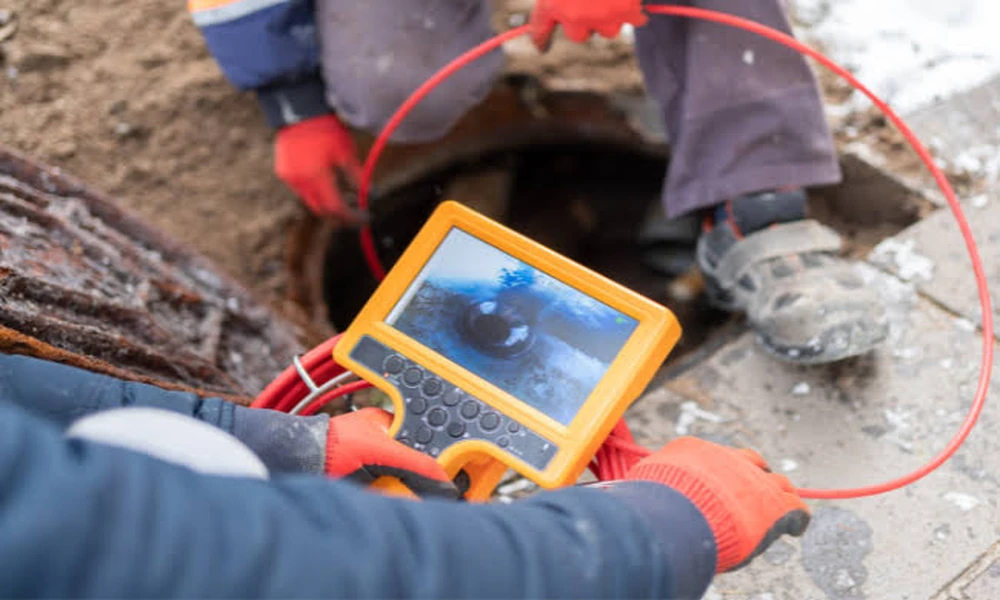
A sewer scope uses a waterproof camera on a long flexible push rod. The inspector feeds it into the line through a cleanout. A cleanout is a capped pipe, usually near the foundation or in the yard, that gives direct access to the main drain. Some inspectors go in through a roof vent instead.
As the camera moves forward, it records video and tracks distance. Many systems also have a locator that marks on the ground exactly where the camera head is. If the camera finds a problem 38 feet out, the locator shows where that spot sits in the yard, which helps when it’s time to estimate a repair.
Finding a cleanout is sometimes the hardest part. Older homes may not have one, or it may be buried under landscaping. If there’s no cleanout, a plumber may pull a toilet to get the camera in, or recommend adding a cleanout, which also makes future drain work easier.
What the Footage Can Reveal
InterNACHI, the home inspectors’ association, publishes standards of practice for sewer scope inspections. They list the conditions an inspector should report, from cracks and root intrusion to offsets, standing water and collapsed sections. Here’s what the most common findings mean.
Roots. Tree roots look for moisture and find it at pipe joints. Fine hair-like roots at one joint are a maintenance problem. A thick mass filling the pipe means the joint has opened and the problem will come back.
Bellies. A belly is a low spot where the pipe has sagged, usually because the soil underneath settled. Water and waste collect there instead of flowing on. On camera, it looks like a pool of standing water the lens dips into.
Offsets. When one section of pipe shifts out of line with the next, it leaves a ledge that catches paper and debris. Small offsets are common in older clay lines. Large ones lead to repeated clogs.
Material problems. Each pipe material fails in its own way. Clay pipe cracks and lets roots in at the joints. Cast iron builds up rust and scale inside, and over time the bottom of the pipe can rust through. Orangeburg pipe, made from tar-soaked wood fiber in the middle of the last century, can flatten into an oval or fall apart completely. Modern PVC holds up well but can still sag or separate if it was installed poorly.
Grease and buildup. Thick deposits on the pipe walls point to kitchen habits more than a broken pipe. Cleaning often fixes them, though it’s still worth knowing about before you move in.
Which Homes Make the Strongest Case
Age is the biggest factor. Houses built several decades ago often still have their original clay or cast iron lines, which may be near the end of their life. Mature trees near the line raise the risk too, especially large species with spreading roots planted close to where the pipe runs.
Newer homes aren’t automatically safe. Construction crews sometimes damage lines while grading, and poorly packed trench soil can settle and cause bellies within the first few years. A home that sat empty for months before going on the market also deserves a look, because a dry, unused line hides problems that heavy daily use would have revealed.
Homes on septic systems benefit as well. A camera can confirm that the line to the tank is intact and properly sloped. That’s a separate question from the condition of the tank and drain field.
Using the Results at the Negotiating Table
A clean report gives you peace of mind and a recorded baseline for the future. Keep the video file, because comparing it with a later inspection shows whether anything has changed.
A report with problems isn’t necessarily a reason to walk away. It turns an unknown risk into a specific item you can negotiate. Buyers often ask the seller to fix the problem before closing, to lower the price, or to give a credit toward the work. A written repair estimate based on the footage makes any of those requests stronger.
Repair methods vary as widely as costs do. Some root problems respond to cleaning and regular maintenance. A single damaged section can sometimes be dug up and replaced. Longer runs may suit trenchless methods, such as lining the old pipe or pulling a new one through it, which avoids tearing up the whole yard. Which one fits depends on the pipe material, how deep it’s buried, and how much of the line is affected.
Timing matters most. A scope booked early in the inspection period leaves room to get a repair quote, have a second camera run if the results are unclear, and negotiate before the deadline. A scope done after closing only gives you information. A scope done before closing gives you leverage.